Sacred ritual instruments
ཚིག་མཛོད།

Glossary

Lexicon

The Living Vocabulary of Jonang

ཇོ་ནང་བཀའ་བབས་ཀྱི་ཐ་སྙད་ཚིག་མཛོད།

A scholarly index of Tibetan, Sanskrit, and English philosophical, tantric, and monastic terminology. Each term is cataloged with its canonical Tibetan Uchen script, Wylie transliteration, and doctrinal context.

philosophy #abhidharma
ཆོས་མངོན་པ།

Abhidharma (Higher Knowledge / Phenomenology)

Wylie: chos mngon pa Skt: Abhidharma

Abhidharma ('Higher Doctrine' or 'Phenomenology') is the third basket (piṭaka) of the Buddhist canon. It maps the human mind through detailed classifications of consciousness, positive and afflictive mental factors (caitta), karma, and the 75 or 100 dharmas. Monastic students at Jonang study Vasubandhu's Abhidharmakośa to ground their philosophical training.

philosophy #agantukamala
གློ་བུར་གྱི་དྲི་མ།

Āgantukamala (Adventitious Obscurations)

Wylie: glo bur gyi dri ma Skt: Āgantukamala

Āgantukamala ('incidental or adventitious stains') is a central concept in Tathāgatagarbha and Shentong doctrine. It asserts that ignorance, desire, aversion, and karmic patterns are not intrinsic to consciousness—they are like clouds veiling the sun or dust coating a diamond. When these superficial stains are purified through the contemplative path, the innate, uncreated virtues of Buddha-nature emerge effortlessly.

kalachakra #avadhuti
དབུ་མ།

Avadhūti (Central Channel / Uma)

Wylie: dbu ma Skt: Avadhūti

The avadhūti (Tibetan: dbu ma) is the central pathway of the subtle energetic body in Anuttarayoga Tantra. Flanked by the left (lalanā) and right (rasanā) channels, it represents the non-dual axis of spiritual transmutation. In Kālacakra practice, the yogi causes the karmic winds to enter, abide, and dissolve into the avadhūti, triggering the dawn of immutable bliss and unhindered empty form.

འབའ་མདའ་དགེ་ལེགས་རྒྱ་མཚོ།

Bamda Gelek Gyatso

Wylie: 'ba' mda' dge legs rgya mtsho

Bamda Thupten Gelek Gyatso (1844–1904) was a master of the rimé (non-sectarian) movement and one of the greatest commentators on the Kālacakra. His extensive multi-volume practice manual, 'A Ray of Sunlight' (Nyin byed snang ba), provides the detailed liturgical and physical guidance utilized to this day in Jonang retreat centers.

kalachakra #bindu
ཐིག་ལེ།

Bindu (Subtle Drops)

Wylie: thig le Skt: Bindu

Bindus (Tibetan: thig le) are the subtle drops or essences located in the energy centers of the subtle body, categorized into white bodhicitta (lunar/cooling) and red bodhicitta (solar/warming). In advanced Kālacakra meditation, the melting and immobilization of these drops at the crown and other cakras generates the 21,600 moments of unchanging great bliss.

practice #bodhicitta
བྱང་ཆུབ་ཀྱི་སེམས།

Bodhicitta (Awakening Mind)

Wylie: byang chub kyi sems Skt: Bodhicitta

Bodhicitta is the heartbeat of all Mahāyāna and Vajrayāna paths. It is divided into conventional bodhicitta (comprising aspirational bodhicitta to liberate beings and practical bodhicitta through the six pāramitās) and ultimate bodhicitta, which is the direct, non-dual realization of emptiness and luminous wisdom.

བྱང་ཆུབ་སེམས་དཔའ།

Bodhisattva (Awakening Being)

Wylie: byang chub sems dpa' Skt: Bodhisattva

A Bodhisattva ('awakening warrior') vows to attain full Buddhahood solely for the universal salvation of all suffering beings. Cultivating the six transcendental perfections (generosity, ethics, patience, diligence, meditation, and wisdom), Bodhisattvas traverse the ten spiritual grounds (bhūmi) until total Buddhahood is realized.

monastic #cham
འཆམ།

Cham (Sacred Monastic Masked Dance)

Wylie: 'cham

Cham ('cham) is a living ritual art form and dynamic meditation. Monks visualize themselves as meditational deities and wrathful protectors, moving in precise geometric patterns accompanied by cymbals, long horns (dungchen), and drums. The dance cleanses the environment of negative karmic forces and transmits blessings to the community.

practice #chod
གཅོད།

Chöd (Severance)

Wylie: gcod

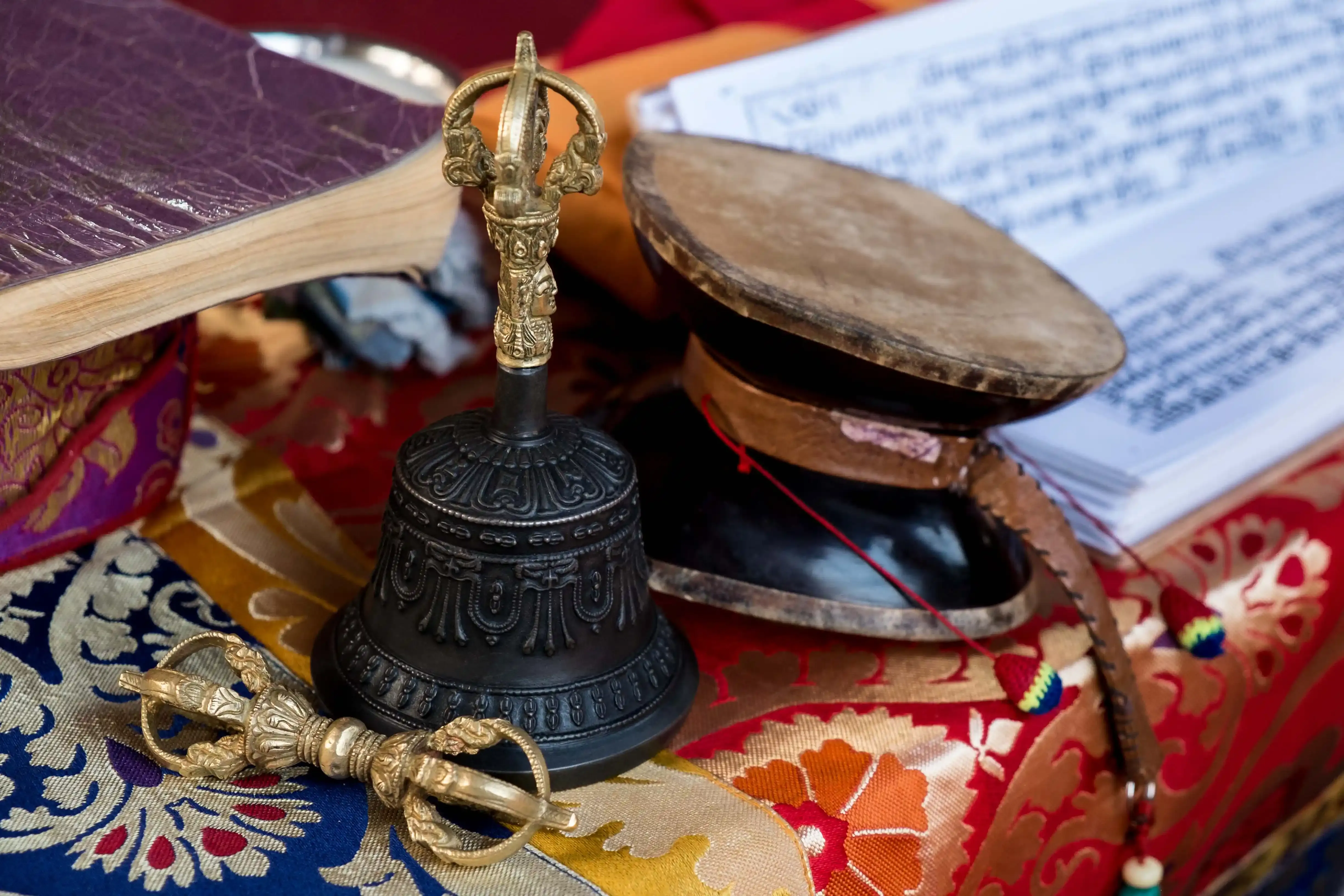
Chöd ('severance' or 'cutting through') is a profound meditation system originated by the Indian master Padampa Sangye and the great Tibetan yoginī Machig Labdrön. Practiced in charnel grounds and desolate places using a bell, ḍamaru drum, and thighbone trumpet (kangling), it cuts through root ego-grasping by offering the meditator's visualized body as an ambrosial feast.

monastic #chos-rwa
ཆོས་རྭ།

Chos Rwa (Monastic Debate Courtyard)

Wylie: chos rwa

The chos rwa ('dharma enclosure') is the vibrant heart of monastic intellectual life. Monks face each other in intense dialectical debate, punctuated by clapping hands, stamping feet, and snapping rosaries. This dynamic pedagogy ensures that scriptural understanding is not merely memorized, but scrutinized and verified with razor-sharp logic.

philosophy #cittamatra
སེམས་ཙམ་པ།

Cittamātra (Mind-Only / Yogācāra)

Wylie: sems tsam pa Skt: Cittamātra / Vijñānavāda

Cittamātra ('Mind-Only') or Yogācāra asserts that external physical objects do not exist independently of cognition; all perceived dualities are projections of karmic imprints in the storehouse consciousness (ālayavijñāna). Jonang masters integrate the Yogācāra analysis of consciousness with Madhyamaka emptiness, synthesizing them into the Great Middle Way of Other-Emptiness.

monastic #dam-bca-pa
དམ་བཅའ་བ།

Dam Bca' Pa (Defender in Monastic Debate)

Wylie: dam bca' ba

In traditional Tibetan monastic debate, the dam bca' pa sits calmly and must defend their scriptural thesis against rapid-fire questions and absurd consequences (prasaṅga). They must answer strictly with precise formal formulas: 'I accept,' 'The reason is not established,' or 'There is no pervasion.'

practice #dbang
དབང་།

Dbang (Tantric Empowerment / Abhiṣeka)

Wylie: dbang Skt: Abhiṣeka

Dbang (Sanskrit: Abhiṣeka, 'empowerment' or 'consecration') is the gateway to all tantric practice. In the Kālacakra tradition, initiation encompasses the Seven Empowerments of Entering Like a Child, the Four High and Highest Empowerments, and the Great Vajra Master Empowerment, cleansing the disciple's body, speech, mind, and drops.

philosophy #dharmadhatu
ཆོས་ཀྱི་དབྱིངས།

Dharmadhātu (Expanse of Reality)

Wylie: chos kyi dbyings Skt: Dharmadhātu

Dharmadhātu refers to the true nature of phenomena, the ultimate reality in which all things abide beyond birth, death, and conceptual duality. In Jonang thought, the Dharmadhātu is not a barren nothingness or conceptual negation, but the luminous, intrinsically pure expanse inseparable from wisdom (jñāna) and Buddha-nature.

lineage #dolpopa
དོལ་པོ་པ་ཤེས་རབ་རྒྱལ་མཚན།

Dölpopa Sherab Gyaltsen

Wylie: dol po pa shes rab rgyal mtshan

Dölpopa Sherab Gyaltsen (1292–1361) was the pivotal luminary of the Jonang tradition. After extensive study across all Tibetan traditions, he arrived at Jonang and experienced a transformative breakthrough while practicing the Six-Branch Yoga. He authored the monumental 'Mountain Dharma: Ocean of Definitive Meaning' (Ri chos nges don rgya mtsho) and constructed the Kumbum Stūpa at Jomonang, establishing Jonang as a paramount seat of Buddhist scholasticism.

རྡོ་རྗེ་སློབ་དཔོན།

Dorje Lopön (Vajra Master / Vajrācārya)

Wylie: rdo rje slob dpon Skt: Vajrācārya

A Dorje Lopön (Vajra Master) is a highly realized practitioner who has completed rigorous monastic training and multi-year contemplative retreats. They oversee the retreat facility, guide candidates through the subtle completion stages of Kālacakra, and maintain the purity of the samayas.

འབྲོ་ལུགས།

Dro Lineage (Dro-luk)

Wylie: 'bro lugs

The Dro Lineage ('bro lugs) was established in Tibet by the Kashmiri master Somanātha and the great Tibetan translator Dro Lotsāwa Sherab Drak (11th century). It emphasizes the practice tradition of the Six-Branch Yoga and profound philosophical commentaries. While the rival Ra Lineage (rwa lugs) focused heavily on ritual recitation, the Dro Lineage became the primary meditative lineage of the Jonang order.

monastic #drupdra
སྒྲུབ་གྲྭ།

Drupdra (Contemplative Retreat Center)

Wylie: sgrub grwa

A drupdra ('place of practice') is the meditation center of a monastery, distinct from the academic shedra. Monks enter the drupdra to complete the canonical three-year, three-fortnight retreat (lo gsum phyogs gsum) in total seclusion, mastering the subtle wind-channel yogas and dark retreats.

monastic #dul-tshon
རྡུལ་ཚོན་དཀྱིལ་འཁོར།

Dul Tshon (Sand Mandala / Dul-tshon Dkyil-'khor)

Wylie: rdul tshon dkyil 'khor

A sand mandala (rdul tshon dkyil 'khor) is constructed over several days by trained monks using narrow metal funnels (chakpur). It represents the divine residence and enlightened qualities of deities like Kālacakra. Upon completion and consecration, the mandala is ritually swept up and offered to a flowing river, demonstrating the impermanence of all composite phenomena.

practice #dzogrim
རྫོགས་རིམ།

Dzogrim (Completion Stage)

Wylie: rdzogs rim Skt: Niṣpannakrama / Sampannakrama

Dzogrim (Completion or Perfection Stage) is the direct, non-conceptual culmination of Vajrayāna praxis. In the Kālacakra tradition, this takes the form of the Six-Branch Yoga, where meditation shifts from conceptual visualization to internal energetic mastery—drawing the karmic winds (prāṇa) into the central channel (avadhūti) to ignite inner heat (caṇḍālī/tummo) and realize supreme, unshakeable bliss and emptiness.

monastic #gandi
གཎྜཱི།

Gaṇḍī (Monastic Slit-Gong)

Wylie: gaN+DI Skt: Gaṇḍī

The gaṇḍī is a traditional carved wooden percussion beam dating back to the time of Buddha Śākyamuni in India. Kept inside the main prayer hall, its sharp, syncopated rhythm summons the Sangha to assemblies, monastic confessions (posadha), and liturgies.

lineage #taranatha
ཇོ་ནང་རྗེ་བཙུན་ཏཱ་ར་ནཱ་ཐ།

Jetsun Tāranātha

Wylie: jo nang rje btsun tA ra nA tha

Jetsun Tāranātha (1575–1634) was one of Tibet's most prolific scholars, meditators, and historians. He revitalized the Jonang lineage during a turbulent period, founded Takten Phuntsok Choeling (Takten Damchö Ling) in Tsang, and composed classic texts such as the 'History of Buddhism in India' (dgya gar chos 'byung) and extensive commentaries on the Kālacakra Six-Branch Yoga and the Tara tantras.

philosophy #jnana
ཡེ་ཤེས།

Jñāna (Primordial Wisdom / Yeshe)

Wylie: ye shes Skt: Jñāna

Jñāna (Tibetan: ye shes, 'primordial knowing') is distinguished from vijñāna (rnam shes, ordinary dualistic consciousness). While consciousness operates through subject-object duality and conceptual fabrications, jñāna is the non-dual, self-illuminating, uncompounded wisdom that perceives ultimate reality directly. In Jonang Shentong, jñāna is permanent, immutable, and replete with the spontaneous enlightened qualities of Buddhahood.

kalachakra #kalachakra
དུས་ཀྱི་འཁོར་ལོ།

Kālacakra (Wheel of Time)

Wylie: dus kyi 'khor lo Skt: Kālacakra

Kālacakra ('Wheel of Time') is the supreme tantric matrix and the crowning jewel of the Jonang lineage. It synthesizes three interdependent realms: the Outer Kālacakra (the macrocosm, celestial motions, and astrology), the Inner Kālacakra (the human microcosm, subtle channels [nāḍī], winds [prāṇa], and drops [bindu]), and the Alternative Kālacakra (the mandalas, initiations, and meditation stages that purify body and mind into the indestructible union of great bliss and empty form).

lineage #kalki
རིགས་ལྡན།

Kalkī (Rigden / Sacred Kings of Shambhala)

Wylie: rigs ldan Skt: Kalkī / Kulika

The Kalkīs (Tibetan: Rigs ldan, 'Holders of the Castes') succeeded the Seven Dharma Kings of Shambhala, beginning with Mañjuśrī Yaśas. They unified all castes into a single vajra family through the Kālacakra initiation. According to tradition, the 25th Kalki, Raudracakrin, will usher in a golden age of Dharma.

རྗེ་བཙུན་དམ་པ།

Khalkha Jetsun Dampa

Wylie: rje btsun dam pa

The Khalkha Jetsun Dampa (Bogd Gegeen) line originated when Zanabazar was recognized as the direct incarnation of Jetsun Tāranātha. The 9th Khalkha Jetsun Dampa (1933–2012) served as the supreme head of the Jonang tradition in exile, consecrating the Main Jonang Takten Phuntsok Choeling monastery in Sanjauli, Shimla.

practice #khrid
ཁྲིད།

Khrid (Experiential Guidance / Pith Instruction)

Wylie: khrid Skt: Upadeśa

Khrid ('guidance' or 'leading step-by-step') refers to practical, experiential meditation instructions derived from the personal realization of lineage masters. Unlike dry scholastic commentaries, khrid manuals (khrid yig)—such as Tāranātha's 'Meaningful to Behold' (Mthong ba don ldan)—provide precise meditation instructions for retreatants.

monastic #kora
སྐོར་བ།

Kora (Sacred Circumambulation / Pradakṣiṇā)

Wylie: skor ba Skt: Pradakṣiṇā

Kora (skor ba) is the devotional practice of walking clockwise around holy temples, stupas, or mountains. Accompanied by prayer wheels and mantra recitation, circumambulation unifies body, speech, and mind in reverence, purifying aeons of negative karma.

monastic #kumbum
སྐུ་འབུམ།

Kumbum (Hundred Thousand Holy Images)

Wylie: sku 'bum

A Kumbum (literally 'one hundred thousand holy images') is an architectural masterpiece of Tibetan Buddhism. The Great Jonang Kumbum, designed and consecrated by Dölpopa in 1333, features multi-storied chapels arranged as a three-dimensional mandala representing the outer, inner, and alternative Kālacakra. Its iconographic murals remain a pinnacle of Himalayan Buddhist sacred art.

lineage #kunpang
ཀུན་སྤངས་ཐུགས་རྗེ་བརྩོན་འགྲུས།

Kunpang Thukje Tsöndru

Wylie: kun spangs thugs rje brtson 'grus

Kunpang Thukje Tsöndru (1243–1313) was the pivotal founding father of the Jonang tradition as an institutional center. After mastering all available Kālacakra commentary traditions in Tibet, he established the primary monastery at Jomonang in 1294, where the lineage took its name.

philosophy #kunzhi
ཀུན་གཞི།

Künzhi (All-Ground Consciousness)

Wylie: kun gzhi Skt: Ālayavijñāna

In Buddhist psychology and Yogācāra philosophy, the Ālayavijñāna (Künzhi) is the eighth consciousness—the repository where latent karmic impressions (vāsanā) are stored and ripen into ordinary dualistic perceptions. In Dölpopa's Shentong writings, a crucial distinction is made between the conditioned, defiled all-ground (kun gzhi rnam shes) and the primordial, unconditioned wisdom-ground (ye shes kyi kun gzhi) which is identical with Buddha-nature.

ཀརྨ་རང་བྱུང་ཀུན་ཁྱབ་ཕྲིན་ལས།

Kyabje Kalu Rinpoche

Wylie: kar ma rang byung kun khyab phrin las

Kyabje Kalu Rinpoche (1905–1989) was one of the earliest Tibetan masters to propagate Vajrayāna Buddhism to the West. Having trained in Jonang Kālacakra transmissions in Eastern Tibet, he took responsibility for preserving the endangered Jonang lineage in India, acquiring and establishing the Sanjauli monastery in Shimla in the 1960s before placing it under the spiritual care of the Jonang order.

practice #kyerim
བསྐྱེད་རིམ།

Kyerim (Generation Stage)

Wylie: bskyed rim Skt: Utpattikrama

Kyerim (Generation or Development Stage) is the meditative process of systematically constructing the visualization of oneself as the meditational deity (yidam) inside the sacred mandala palace. This practice purifies ordinary grasping at mundane birth, death, and intermediate states (bardo), training the mind in divine pride and clarity prior to entering the formless energetic yogas of the completion stage.

kalachakra #lalana-rasana
རྐྱང་མ་དང་རོ་མ།

Lalanā & Rasanā (Left and Right Subtle Channels)

Wylie: rkyang ma dang ro ma Skt: Lalanā & Rasanā

In Vajrayāna subtle physiology, the lalanā (left, white, lunar) and rasanā (right, red, solar) channels run parallel to the central channel and knot around the bodily cakras. These side channels govern ordinary dualistic inhalation and exhalation. Through the six yogas of Kālacakra, these dualistic energies are drawn inward and untied, releasing their winds into the central channel.

practice #lung
ལུང་།

Lung (Scriptural Reading Transmission)

Wylie: lung Skt: Āgama

A lung ('authorizing transmission') is the oral reading of a scripture, ritual liturgy, or commentary by a lineage master who received it in an unbroken chain from the author. It awakens the receptive potency in the student's mind and authorizes them to read and practice the text.

philosophy #madhyamaka
དབུ་མ་པ།

Madhyamaka (Middle Way)

Wylie: dbu ma pa Skt: Mādhyamika / Madhyamaka

Founded by Ārya Nāgārjuna in the 2nd century CE based on the Prajñāpāramitā sūtras, Madhyamaka ('Middle Way') demonstrates through rigorous dialectic that nothing possesses intrinsic, independent existence. Jonang philosophy categorizes Madhyamaka into Rangtong Madhyamaka (which negates self-existence in relative phenomena) and Shentong Madhyamaka (The Great Middle Way / dbu ma chen po, which affirms the unconditioned reality of ultimate wisdom).

kalachakra #mahasukha
བདེ་བ་ཆེན་པོ།

Mahāsukha (Supreme Great Bliss)

Wylie: bde ba chen po Skt: Mahāsukha

Mahāsukha ('Great Bliss') in Kālacakra is not a physical or emotional sensation, but the permanent, unfluctuating realization of the primordial Buddha nature. When the 21,600 karmic winds are transmuted into wisdom winds, the yogi experiences 21,600 moments of immutable bliss (acalasukha), culminating in complete enlightenment.

monastic #mar-me
མར་མེ།

Mar Me (Butter Lamp / Dīpa)

Wylie: mar me Skt: Dīpa

Butter lamps (mar me) are ubiquitous offerings in Himalayan Buddhist temples. Filled with pure clarified butter and lit with a cotton wick, their steady, golden flames represent the illumination of prajñā and the removal of the two obscurations.

kalachakra #mun-khang
མུན་ཁང་།

Mun Khang (Dark Retreat Hermitage)

Wylie: mun khang

A mun khang ('dark house' or 'dark cell') is an architectural sanctuary constructed to block all external photons. In this total sensory void, the practitioner isolates the physical senses (lus dben), speech (ngag dben), and mind (yid dben). Free from visual sensory stimulation, the ocular consciousness subsides and the ten visionary signs of empty form shine forth directly from Buddha-nature.

kalachakra #nadi
རྩ།

Nāḍī (Subtle Channels)

Wylie: rtsa Skt: Nāḍī

In Buddhist tantric physiology, nāḍīs are the internal subtle energetic pathways. The system centers around three primary channels: the central channel (avadhūti / dbu ma), flanked by the left lunar channel (lalanā / rkyang ma) and right solar channel (rasanā / ro ma), intersecting at various wheels or centers (cakras). Kālacakra yoga directs all turbulent energy into the central channel.

philosophy #neyartha
དྲང་དོན།

Neyārtha (Provisional Meaning)

Wylie: drang don Skt: Neyārtha

Neyārtha ('interpretable or provisional meaning') refers to discourses where the Buddha spoke using conventional metaphors, dualistic frameworks, or intermediate negations to guide beings away from gross clinging. According to Jonang masters, teachings that stop at mere absence or non-affirming negation without revealing luminous wisdom serve as provisional stepping stones toward the definitive Shentong realization.

practice #ngondro
སྔོན་འགྲོ།

Ngöndro (Foundational Practices)

Wylie: sngon 'gro

Ngöndro ('preliminaries' or 'prior step') constitutes the indispensable bedrock of Tibetan Vajrayāna. It consists of the Common Preliminaries (the Four Mind-Turnings on impermanence, karma, suffering, and precious human rebirth) and the Uncommon Preliminaries: 500,000 accumulations of prostrations with refuge, bodhicitta, Vajrasattva purification, maṇḍala offerings, and Guru Yoga.

philosophy #nitartha
ངེས་དོན།

Nītārtha (Definitive Meaning)

Wylie: nges don Skt: Nītārtha

In Buddhist hermeneutics, nītārtha ('definitive meaning') denotes scriptures and teachings that articulate the ultimate truth directly, in contrast to neyārtha ('provisional meaning') which uses pedagogical devices adapted to disciples' capacities. The Jonang school considers the Third Turning of the Dharma Wheel and the Kālacakra Tantra as the supreme nītārtha revelations of the Buddha.

monastic #pecha
དཔེ་ཆ།

Pecha (Traditional Loose-Leaf Text)

Wylie: dpe cha

A pecha (dpe cha) is the sacred physical format of Tibetan religious and philosophical literature. Inherited from Indian palm-leaf (pattra) manuscripts, pechas consist of long, narrow horizontal pages wrapped inside sacred cloth cloths and secured between wooden boards. In monastic study, pechas are treated with the highest veneration as representations of the Buddha's speech (Dharma).

Related: vinaya
ཤེས་རབ་ཀྱི་ཕ་རོལ་ཏུ་ཕྱིན་པ།

Prajñāpāramitā (Perfection of Wisdom)

Wylie: shes rab kyi pha rol tu phyin pa Skt: Prajñāpāramitā

Prajñāpāramitā ('Perfection of Transcendent Wisdom') is the central corpus of Mahāyāna literature (such as the Heart Sūtra and Diamond Sūtra) and the supreme of the six pāramitās. It reveals that all phenomena are unborn, unceasing, and free from conceptual extremes. In the Jonang monastic curriculum, it is studied extensively through Maitreya's Abhisamayālaṃkāra.

philosophy #pramana
ཚད་མ།

Pramāṇa (Valid Cognition / Epistemology)

Wylie: tshad ma Skt: Pramāṇa

Pramāṇa (Tibetan: tshad ma, 'valid cognition') is the epistemology and formal logic system utilized throughout Tibetan monastic debate (shedra). It accepts two valid means of knowledge: direct perception (pratyakṣa) and inferential reasoning (anumāna). Jonang scholars mastered Dharmakīrti's Pramāṇavārttika to demonstrate that Shentong is not only experientially realized in tantric yoga, but also completely invulnerable to logical refutation.

kalachakra #prana
རླུང་།

Prāṇa (Vital Winds)

Wylie: rlung Skt: Prāṇa / Vāyu

Prāṇa (Tibetan: rlung) is the vital wind or subtle life energy. Mind and prāṇa are regarded as rider and horse: erratic mental chatter is driven by karmic winds (las kyi rlung). Through the breath-control branch (prāṇāyāma) of the Six-Branch Yoga, these dispersed winds are gathered and dissolved into the wisdom wind (ye shes kyi rlung) within the central channel.

རྭ་ལུགས།

Ra Lineage (Ra-luk)

Wylie: rwa lugs

The Ra Lineage (rwa lugs) is one of the two major historical streams of the Kālacakra Tantra in Tibet, brought from Nepal by Ra Lotsāwa Dorje Drak. In contrast to the Dro tradition which emphasizes internal meditative realization and the Six-Branch Yoga, the Ra tradition is noted for its extensive ritual manuals and protective wrathful rites. Jonang masters studied both, but anchored their practice in the Dro lineage.

philosophy #rangrik
རང་རིག

Rangrik (Self-Awareness / Self-Cognition)

Wylie: rang rig Skt: Svasaṃvedana / Svasaṃvitti

Rangrik (Self-cognition or reflexive awareness) is consciousness's inherent ability to illuminate and know itself immediately, without being split into an external subject observing an object. While critically analyzed in Prāsaṅgika Madhyamaka, Jonang and Yogācāra scholars affirm that on the ultimate level, the luminous nature of primordial mind is inherently self-illuminating and self-aware.

philosophy #rangtong
རང་སྟོང་།

Rangtong (Self-Emptiness)

Wylie: rang stong Skt: Svabhāva-śūnyatā

Rangtong ('self-emptiness') holds that all phenomena without exception—both conventional truths and the ultimate truth—are entirely empty of any inherent, intrinsic reality (svabhāva). In Tibetan scholastic debate, Shentong masters do not reject Rangtong, but rather maintain that Rangtong perfectly describes the relative, conditioned realm of dependent origination taught in the Second Turning of the Dharma Wheel, while Shentong represents the definitive realization of the Third Turning.

kalachakra #sahajakaya
ལྷན་སྐྱེས་ཀྱི་སྐུ།

Sahajakāya (Co-emergent Body of Fruition)

Wylie: lhan skyes kyi sku Skt: Sahajakāya

Sahajakāya ('Co-emergent or Innate Body') is celebrated in the Jonang Kālacakra tradition as the crowning fruition of the spiritual path. It transcends ordinary dualisms of samsara and nirvana, embodying the Primordial Buddha (Ādibuddha) Kālacakra in full perfection, endowed with the 32 major and 80 minor marks without a single physical atom.

kalachakra #shambhala
ཤambhala / ཤམ་བྷ་ལ།

Shambhala

Wylie: sham bha la Skt: Śambhala

According to tradition, King Sucandra of Shambhala requested the Kālacakra Tantra from Buddha Śākyamuni at the Dhānyakaṭaka Stūpa in South India. Sucandra returned to Shambhala to write down and practice the root tantra. Ruled by seven Dharma Kings and twenty-five Kalki rulers (Kulika), Shambhala is described both as a sacred geographic pure land and an inner state of spiritual realization.

monastic #shedra
བཤད་གྲྭ།

Shedra (Monastic Philosophical College)

Wylie: bshad grwa

A shedra ('place of explanation') is the formal university of Tibetan Buddhist monasticism. Monks undertake a rigorous 9 to 13-year curriculum studying the Five Great Treatises: Prajñāpāramitā, Madhyamaka, Pramāṇa, Abhidharma, and Vinaya, accompanied by daily dialectical debates in the courtyard (chos rwa).

philosophy #shentong
གཞན་སྟོང་།

Shentong (Other-Emptiness)

Wylie: gzhan stong Skt: Paratantra-śūnyatā / Parasūnya

Shentong ('other-emptiness') is the distinctive hermeneutical view formulated and championed by the Jonang master Dölpopa Sherab Gyaltsen (1292–1361). In contrast to Rangtong ('self-emptiness'), which emphasizes that all phenomena are empty of self-nature (svabhāva), Shentong distinguishes between conventional and ultimate reality. Conventional, conditioned phenomena (relative truth) are empty of their own nature. However, the ultimate nature—luminous awareness, Dharmadhātu, and Buddha-nature (Tathāgatagarbha)—is unconditioned, unchanging, and permanent, empty only of extraneous, adventitious defilements (kleśa) that temporarily obscure it.

སྦྱོར་བ་ཡན་ལག་དྲུག

Six-Branch Yoga (Ṣaḍaṅgayoga)

Wylie: sbyor ba yan lag drug Skt: Ṣaḍaṅgayoga

The Six-Branch Yoga (Ṣaḍaṅgayoga) forms the core contemplative praxis preserved unbroken in the Jonang tradition. The six stages are: 1) Withdrawal (pratyāhāra / sor sdud), 2) Meditative Absorption (dhyāna / bsam gtan), 3) Breath Control (prāṇāyāma / srog rtsol), 4) Retention (dhāraṇā / 'dzin pa), 5) Recollection (anusmṛti / rjes dran), and 6) Meditative Concentration (samādhi / ting nge 'dzin). Through these branches, the meditator binds the karmic winds into the central channel, giving rise to empty forms and unchanging great bliss.

kalachakra #stong-gzugs
སྟོང་གཟུགས།

Stong Gzugs (Empty Form / Śūnyatā-bimba)

Wylie: stong gzugs Skt: Śūnyatā-bimba / Pratibhāsa

Stong gzugs ('Empty Form') is the hallmark realization of the Kālacakra Six-Branch Yoga. Unlike ordinary mental imagery produced by conceptuality, empty forms arise spontaneously in dark retreat and sky-gazing as reflections of ultimate reality—replete with color, light, and deity forms, yet completely uncompounded by atomic matter (paramāṇu). In union with immutable bliss, empty form constitutes the Sambhogakāya.

philosophy #sunyata
སྟོང་པ་ཉིད།

Śūnyatā (Emptiness)

Wylie: stong pa nyid Skt: Śūnyatā

Śūnyatā ('emptiness' or 'openness') is the core insight of Mahāyāna Buddhism articulated in the Prajñāpāramitā scriptures. It signifies that phenomena exist solely through dependent origination (pratītyasamutpāda) and lack inherent essence. In the Jonang Shentong formulation, relative conditioned phenomena are empty of self-nature (rangtong), while the ultimate unconditioned reality—luminous awareness and Buddha-nature—is empty only of adventitious obscurations (shentong).

philosophy #svabhava
རང་བཞིན།

Svabhāva (Inherent Nature / Own-Being)

Wylie: rang bzhin Skt: Svabhāva

Svabhāva ('own-nature' or 'inherent existence') refers to the assumed intrinsic reality of phenomena that Buddhist dialectics thoroughly refute. Nāgārjuna demonstrated that if a phenomenon had svabhāva, it could never arise, change, or cease. In Shentong, while conventional entities are devoid of svabhāva, the ultimate dharmatā is an uncompounded, primordially enduring reality that never undergoes degeneration.

བདེ་བར་གཤེགས་པའི་སྙིང་པོ།

Tathāgatagarbha (Buddha-Nature)

Wylie: bde bar gshegs pa'i snying po Skt: Tathāgatagarbha

Tathāgatagarbha, literally the 'embryo or matrix of the Thus-Gone One' (Buddha), is the luminous core of enlightened awareness present in all living beings. In the Jonang Shentong tradition, as articulated in the Uttaratantraśāstra (Ratnagotravibhāga), Buddha-nature is not merely a metaphor or a seed to be manufactured, but the actual, fully endowed ultimate reality of wisdom and compassion obscured only by adventitious delusions.

ཐལ་འཕེན་པ།

Thal 'Phen Pa (Challenger in Monastic Debate)

Wylie: thal 'phen pa

The thal 'phen pa ('launcher of consequences') stands, circles, and energetically challenges the defender's assertions by exposing hidden contradictions. Emphasizing each deduction with a rhythmic downward clap of the hands and a stamp of the foot, the challenger drives the inquiry to root philosophical clarity.

ཆོས་འཁོར་རིམ་པ་གསུམ།

Three Turnings of the Dharma Wheel

Wylie: chos 'khor rim pa gsum Skt: Tridharmacakrapravartana

As set forth in the Saṃdhinirmocanasūtra, the Buddha turned the Wheel of Dharma three times: 1) The First Turning at Vārāṇasī taught the Four Noble Truths and impermanence for early disciples; 2) The Second Turning at Rājagṛha taught universal emptiness (Prajñāpāramitā); 3) The Third Turning at Vaiśālī and Mount Malaya revealed the definitive (nītārtha) ultimate reality of luminous awareness, Buddha-nature, and unconditioned wisdom. Jonang regards the Third Turning as the ultimate definitive teaching.

monastic #torma
གཏོར་མ།

Torma (Ritual Offering Cake)

Wylie: gtor ma Skt: Balingta

Tormas (gtor ma) are physical offering sculptures central to Tibetan ritual liturgy. Modeled from dough and decorated with delicate butter ornamentation (kar rgyan), tormas serve multiple functions: as representations of deities, as feasts of spiritual sustenance for protectors, and as tools for casting out adversities.

practice #trulkhor
འཁྲུལ་འཁོར།

Trulkhor (Yantra Yoga / Physical Postures)

Wylie: 'khrul 'khor Skt: Yantra-yoga

Trulkhor ('magical wheel' or 'movement machine') consists of dynamic yogic postures, muscle locks, and breath retentions designed to eliminate energetic knots in the subtle channels. In the Jonang Kālacakra retreat curriculum, trulkhor movements are practiced to prepare the physical body for prolonged dark retreat and the Six-Branch Yoga.

monastic #tsa-tsa
ཚ་ཚ།

Tsa-Tsa (Sacred Votive Clay Reliefs)

Wylie: tsha tsha

Tsa-tsas (tsha tsha) are sacred votive tablets stamped from metal molds using clay mixed with medicinal herbs, flower petals, and holy relics. After being painted and consecrated, thousands of tsa-tsas are entombed inside stupas, prayer walls, and pilgrimage shrines to magnify merit.

kalachakra #tummo
གཏུམ་མོ།

Tummo (Inner Heat / Caṇḍālī)

Wylie: gtum mo Skt: Caṇḍālī

Tummo (Sanskrit: Caṇḍālī, 'fierce woman') is one of the most celebrated completion-stage yogas. By focusing breath retention, subtle body postures, and visualization at the navel cakra, an inner fire blazes upward through the central channel. This melts the white bodhicitta drop at the crown, causing it to descend and trigger the Four Joys (ānanda) and the realization of ultimate emptiness.

monastic #vinaya
འདུལ་བ།

Vinaya (Monastic Discipline)

Wylie: 'dul ba Skt: Vinaya

The Vinaya (Tibetan: 'dul ba, 'taming') is the foundational monastic ethical framework instituted by the Buddha to guide the Sangha. Tibetan monasticism, including the Jonang tradition, upholds the Mūlasarvāstivāda Vinaya lineage, requiring full monks (gelong) to observe 253 rules covering celibacy, non-harm, poverty, and communal harmony.

Related: pecha
practice #yidam
ཡི་དམ།

Yidam (Meditational Deity / Iṣṭadevatā)

Wylie: yi dam Skt: Iṣṭadevatā

Yidam (contracted from yid kyi dam tshig, 'mind-bond') is a personal meditational deity such as Kālacakra, Cakrasaṃvara, or Tārā. The practitioner visualizes themselves as the yidam to dissolve mundane ego-identity and actualize pure perception. In Jonang praxis, the supreme yidam is glorious Kālacakra embraced by Viśvamātā.

ཐོག་མ་དབུས་མཐའ་མེད་པ་ཡི། །རང་བཞིན་ཡིན་ཕྱིར་འདུས་མ་བྱས། །ཞི་བ་ཆོས་ཀྱི་སྐུ་ཅན་ཕྱིར། །ལྷུན་གྱིས་གྲུབ་ཅེས་བྱ་བར་བརྗོད། །

It is unconditioned because its nature
Is to be without beginning, middle, and end.
It is declared to be effortless
Because it possesses the peaceful dharma body.

Ratnagotravibhāga Root Verse I.6